![[Pagtatahip Blog] Residency Week 1: Assembling Echoes in Berlin](https://site.meleyamomo.com/wp-content/uploads/2025/09/Pagtatahip-Residency-2025.08.15B-scaled.jpg)
2025.08.11-15
The first week was about gathering.
From 11 to 15 August, Nico and I worked in the post-production suite at Humboldt Forum. My main task was assembly: collecting field recordings, cleaning archival materials, and drafting sequences that could one day form the shape of the piece. It was the heavy lifting stage, less about clarity and more about getting everything on the table.
The work moved between archive and present.
I edited interviews with my father in Pangasinan, cleaned field recordings made with Jay, and clipped voices from the Berlin Phonogramm-Archiv and the Lautarchiv. Wax cylinders, soldiers’ counting, a Kalinga chant from 1933—all entered the draft alongside contemporary recordings. What emerged was less a linear composition than a sound documentary, layering fragments from different decades.
The studio at Humboldt Forum had only a 5.1 system. Ambisonics and wave field synthesis remained, at this stage, still a theory—sonic dreams in my head while listening through stereo headphones. Stereo demands chronology. One sound follows another. I write narrations, and I record my voice on Nico’s TASCAM. The piece’s sonic narrative form at this stage sounds too much like a sound documentary, I worried. Yet perhaps necessary scaffolding, a temporary spine to hold the fragments together until they could be expanded into space, where simultaneity and multiple temporalities might emerge.
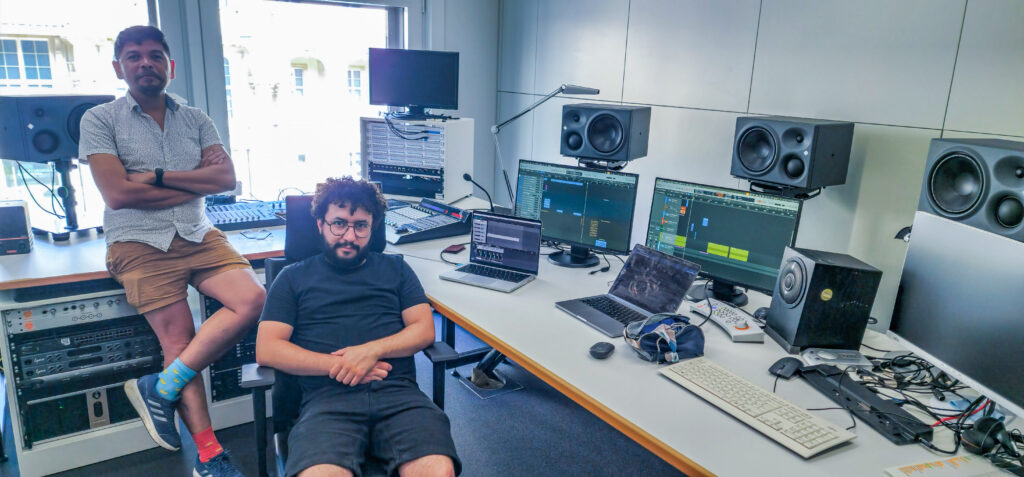
Editing was both technical and compositional. I worked with iZotope RX11, cleaning archival recordings, and sometimes reversing the process—removing the voices to keep the noise, holding on to the hiss and mechanical breath of the medium. Nico experimented with RX10, testing music rebalance functions to isolate voices, percussion, or bass lines. From the wax cylinders came sympathetic vibrations and machine sounds, sometimes amplified during digitization, sometimes ghosts of the device itself. We captured them, too. They became part of the material.
This was the daily rhythm: listening, clipping, sequencing, discarding, and beginning again. By the end of the week, I had a draft—too long, narrative-heavy, but alive.
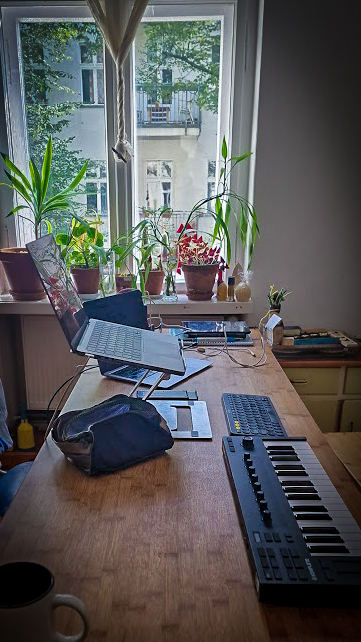
Outside the Humboldt Forum, Neukölln offered another rhythm. During the day, Nico and I worked in the Humboldt Forum. At night, I carried the files back to Fabian Larsson’s apartment in Neukölln, where I stayed while his family was away. I often worked late into the evening, energized by the noise and rhythm of the neighborhood. During breaks, I walked to the Turkish nut shop or to Al Faisal Grills around the corner, where the dürüm was simple and exact: grilled ingredients, Turkish bread, garlic sauce, baba ghanoush. Not oversized, not embellished. Like good editing, it was pared down to essentials. These meals and the streets themselves gave a pulse to the work, a counterpoint to the focused silence of cutting sound late at night in headphones.
Technical choices carried conceptual weight.
Cleaning the audio was not just repair but composition. Using RX11, I removed noise, but I also experimented with isolating and extracting it—taking mechanical traces from the wax cylinders, or teasing apart voices from percussive sounds. Noise itself became material. Each technical adjustment opened a philosophical question: what counts as the sound, what as its remainder?
Conversations opened new perspectives. Over lunches with Maurice Mengel, we spoke about institutional structures at the Forum and the place of the Phonogramm-Archiv within them. The discussions ranged from politics in Berlin to the entanglements of ethnomusicology and media. These exchanges were less about answers and more about holding the complexity in view: how sound moves between archive, museum, and composition.
Pagtatahip is an investigation into modes of listening. We inherit them through schooling, through media, through the disciplinary habits of radio, documentary, and ethnography. We are trained to hear field recordings as realism or naturalism, as documents of place and time. We are taught to listen to archives as sacred objects, preserved with care, played with reverence.
But what happens if these habits are unsettled? If the recordings are not presented as relics, nor as transparent documents, but broken down—granularized—and recomposed as sonic sources? This was one of the questions I carried into the residency. Some materials I wanted to present directly, as snippets recognizably “archival” or “field.” Others, I wanted to fracture into particles, to use as grains for synthesis, to shape new sonic motives and textures.
My first encounter with the Phonogram Archive was in 2013, during a summer school organized by Jürgen Osterhammel and Harry Liebersohn at the Wissenschaftskolleg Berlin. Since then, the archive has been a recurring frequency in my work. I finished my PhD in 2014, applied for postdoc projects in 2015 and 2016, and joined the Interweaving Performance Cultures Research Center at Freie Universität as a fellow. Over the past decade, I have returned to these recordings in different forms: in podcasts, in performances like Echoing Europe (premiered 2019), in smaller sound pieces. Each return has been another attempt to listen differently, to ask again how we are shaped by the ways we are taught to listen.
Pagtatahip is another return, another attempt. By reframing these materials within spatial sound, I hope to move beyond the linear logics of documentary and narration, toward something less logocentric, more sonic. Toward listening that admits simultaneity, resonance, and rupture.
By the end of the week, the piece remained unresolved.
The drafts were still too long, narration carried too much weight, and the structure was unclear. But something was forming. The scenes acted as containers for fragments, a way of hearing how they might relate before deciding what to cut. The composition was still scaffolding, but the act of assembling—bringing together voices from the archive and from my own life—was already shaping the path forward. Berlin, Neukölln, the Forum, the archives, the dinners, the conversations—all these resonances entered the work. Each carried its own rhythm, its own interference, its own tone. Week one was only an overture, but the piece is sounding. ☐